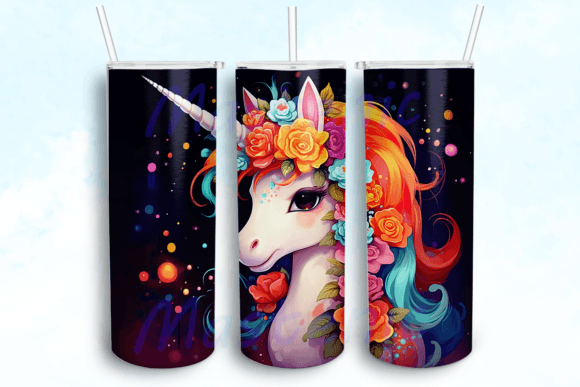
Baby Unicorn Tumbler Sublimation Design
Let’s be real: I opened this file expecting a cute, pastel-heavy sublimation graphic—and got something far more versatile than the title suggests. As a designer who’s stitched unicorns on everything from newborn onesies to boutique aprons, I immediately asked: Could this work beyond tumblers? The answer is yes—but only if you treat it like a design asset, not just a ready-to-press graphic.
First Impression: Sweet, Simple, and Surprisingly Scalable
The Baby Unicorn Tumbler Sublimation Design lands with soft charm—not saccharine, not overly detailed, but confidently minimal. It’s a single-facing unicorn with a tiny horn, rounded ears, and a gentle smile. No glitter trails, no rainbow manes, no floating stars. Just clean lines, balanced negative space, and subtle curvature that hints at the tapered tumbler shape it was built for. That restraint is its biggest strength. In embroidery, where every stitch adds bulk and complexity, this translates to clarity—not clutter.
I pulled it up beside a few of my go-to baby embroidery files (think: minimalist cloud appliqué, tiny owl patch, embroidered bib monogram) and noticed how well it holds its own. It doesn’t shout. It invites touch. That makes it ideal for products where softness matters—like organic cotton baby blankets, linen tea towels, or unlined canvas tote bags meant for nursery gifts.
Real-Life Test: From Tumbler Graphic to Embroidered Sweatshirt
Last week, I prepped a custom order: a lavender French terry sweatshirt for a new mom’s baby shower gift. She wanted “something magical but not too flashy.” I resized the Baby Unicorn Tumbler Sublimation Design to fit a 4” hoop, converted it to an embroidery file using vector tracing (yes—PNGs need careful prep), and ran a test on scrap fabric first. Here’s what stood out:
- Stitch density feels intentional—not overloaded in the horn or eye, which means less puckering on lightweight knits.
- No fine lettering or micro-details, so no risk of lost definition on textured fleece or brushed cotton.
- The tapered version? A quiet game-changer. When I used it on a curved surface (a baseball cap front panel), the proportions stayed true—no stretching or distortion.
It stitched cleanly on both light and dark fabrics, especially when paired with matte pastel threads (dusty rose, oatmeal, sky blue). Customers didn’t just say “cute”—they said “so gentle” and “feels handmade, not mass-produced.” That’s the difference between decoration and emotional resonance.
Where It Shines—and Where to Pause
This isn’t a one-size-fits-all embroidery file. Its sweet spot is soft product categories: baby embroidery, holiday embroidery for toddlers, personalized gifts with quiet elegance, and small shop products where brand voice leans warm and unhurried.
It works beautifully on:
- Tote bag design (centered on natural canvas)
- Sweatshirt embroidery (left chest or lower back)
- Embroidered patch (heat-seal or sew-on, great for denim jackets)
- Nursery decor (pillow covers, blanket corners, framed hoop art)
- Tea towels and kitchen linens (stitched in ecru thread on ivory linen)
Use caution with:
- Stretchy fabric—like jersey tees—unless you use cutaway stabilizer and reduce stitch speed.
- Dense fill areas on thin fabric—test density; consider swapping heavy fill stitch for satin stitch outlines + light fill.
- Dark fabric without contrast testing—the unicorn’s soft edges can fade visually unless thread color lifts clearly.
- Curved seams or layered garments—hoop placement matters more here; avoid stitching across shoulder seams or waistbands.
Design Judgment for Craft Business Owners
If you’re an Etsy seller or small shop owner building a cohesive line, this design fits seamlessly into collections centered around “first moments,” “gentle magic,” or “quiet celebration.” It pairs naturally with moon phases, tiny clouds, or monogrammed initials—not dragons or neon rainbows. That consistency builds trust. Buyers recognize your aesthetic before they read your shop name.
For commercial embroidery, it’s low-risk: no licensing red flags (though always verify the seller’s terms), no trademarked characters, and no complex gradients that require special thread blending. It also converts well to printable mockups—clients love seeing how it looks on real product photos before ordering.
Practical Notes Every Embroidery Designer Should Check
Before adding Baby Unicorn Tumbler Sublimation Design to your next project, do these five things:
- Test on scrap fabric—especially if using it on baby clothes or items meant for frequent washing.
- Review thread color contrast on both light and dark backgrounds—not just digitally, but stitched.
- Confirm hoop size compatibility; the straight PNG may need resizing for smaller hoops (3.5” or less).
- Inspect small details at 200% zoom—check whether the horn tip or eye stays legible after digitizing.
- Verify usage rights—this is a Graphics file, not pre-digitized embroidery, so confirm whether resale of finished embroidered items is permitted.
And one more thing: don’t skip the stabilizer step. Even on stable woven fabric, that gentle curve benefits from medium-weight tear-away. It keeps the unicorn’s outline crisp—not wobbly—on the finished product.
Final Thought: Not Just a Tumbler Graphic—A Quiet Design Anchor
What makes Baby Unicorn Tumbler Sublimation Design stand out in the Crafts category isn’t its theme—it’s its restraint. In a world of overdesigned digital assets, it leaves room for fabric texture, thread nuance, and human imperfection. That’s what makes it feel handmade, not templated. Whether you’re stitching it onto a holiday embroidery gift for a friend or scaling it across 50 custom tote bags for your small shop, it carries warmth without weight. And in embroidery—where every stitch is a decision—that kind of balance is rare, and valuable.