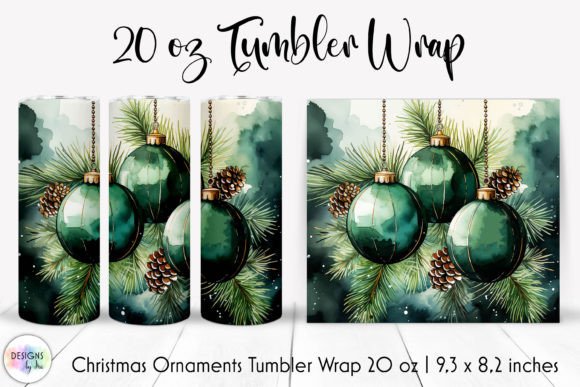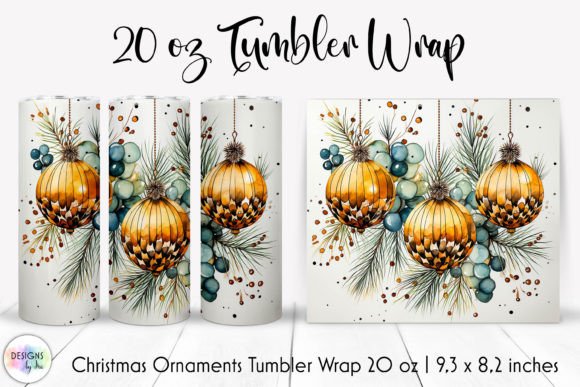
Pine Branches Christmas Bulbs Tumbler
A Watercolour Charm That Translates Well—With Caveats
As someone who’s stitched holiday designs on everything from linen tea towels to newborn onesies, I opened the Pine Branches Christmas Bulbs Tumbler file expecting a soft, festive mood—and got exactly that. The watercolour aesthetic isn’t just decorative; it’s functional for embroidery. The loose brushwork and gentle gradients suggest organic movement, which means fewer hard edges to fight when digitizing or stitching. It feels like a hand-painted sketch brought to life—not stiff, not overly symmetrical, and refreshingly uncluttered.
First Impressions: What This Design *Wants* to Be
This isn’t a bold, high-contrast ornament cluster screaming for attention on a trucker hat. It’s quieter. Think pine boughs draped across a cream-coloured apron, or delicate bulbs nestled into the corner of a baby blanket. The layout flows diagonally—ornaments, pine cones, and subtle branch lines create rhythm without rigidity. That natural asymmetry makes it ideal for curved surfaces (like mugs or tumblers, yes—but also rolled cuffs or pillow hems) and forgiving on imperfect alignment during hooping.
Real Project Test: A Holiday Tote Bag for My Local Boutique
Last week, I prepped a small batch of embroidered canvas totes for a downtown gift shop’s holiday pop-up. I chose Pine Branches Christmas Bulbs Tumbler for the front panel—not full coverage, but scaled down to 4.5" wide, placed off-centre with a simple running-stitch border. Why? Because customers responded to its warmth, not its complexity. One shopper told me, “It looks like something my grandma would’ve painted.” That’s the sweet spot: nostalgic, handmade, unhurried.
On medium-weight canvas with tear-away stabilizer, the design stitched cleanly—even the finer pine needle hints held up. No thread breaks. No puckering. But I did notice: the lightest watercolour washes (especially near bulb highlights) vanished entirely in dense fill stitch. So I adjusted digitizing—swapped those areas for airy satin stitch outlines and open negative space instead of trying to replicate every pixel.
Where It Shines (and Where It Needs Help)
- Custom apparel: Works beautifully on crewneck sweatshirts—especially heather grey or oatmeal. The soft palette reads as elevated, not juvenile.
- Baby embroidery: Perfect for onesies or burp cloths. Gentle scale, no sharp points, and zero text means no readability issues at tiny sizes.
- Embroidered patch: Clean outer shape and moderate detail make it patch-ready—just add a satin-stitched edge and heat-seal backing.
- Holiday gifts & boutique branding: Feels special without being fussy. Great for tea towel sets, kitchen aprons, or linen pillow covers meant to sit on a shelf year after year.
- Etsy listings: Stands out in search results because it avoids overused snowflake or reindeer tropes—yet still reads instantly as “Christmas.”
Use With Intention—Not Assumption
This isn’t a one-size-fits-all machine embroidery design. Its watercolour soul demands thoughtful translation:
- Avoid ultra-small hoop sizes (<5" diameter)—fine branch details lose definition below 3.5" width.
- Textured fabrics (like terry cloth or bouclé) will mute the subtlety. Stick to smooth cotton, linen, or midweight knits.
- Dark fabric? Test contrast first. The palest bulb glows on ecru—but disappears on navy unless you add an underlay or switch to metallic thread.
- Stretchy fabric (e.g., ribbed knit caps) requires extra stabilizer and slower stitching speed—or consider simplifying the design before digitizing.
- Curved surfaces (like tumblers themselves) are where this PNG shines *as a wrap*, but remember: embroidery can’t bend like vinyl. Use it as inspiration for placement, not direct transfer.
Design Integrity Meets Customer Trust
When your customer pays for a “handmade holiday item,” they’re buying intention—not just thread count. Pine Branches Christmas Bulbs Tumbler supports that promise. Its gentle imperfection signals care. It doesn’t look mass-produced, even when stitched on a commercial machine. That builds trust—especially for Etsy sellers or craft fair vendors whose buyers choose them over big-box alternatives.
But here’s what matters more than aesthetics: how it behaves in production. Does it stitch reliably at 8–10,000 stitches? Does it hold up after three rounds of washing? Does it translate well in black-and-white mockups for your listing photos? I recommend always checking those three things before adding it to your digital embroidery file library or client portfolio.
Practical Designer Notes You’ll Actually Use
- Test on scrap fabric *first*—especially if pairing with dark thread on light fabric or vice versa.
- Review stitch density in your embroidery software. Watercolour illusions often need lower density in highlight zones to avoid stiffness.
- Confirm hoop size compatibility. This design fits comfortably in a 5x7 hoop—but verify before sending to production.
- Inspect small details at 200% zoom. Those tiny pine cone textures may simplify better as satin stitch accents than dense fill.
- Mock it up on both light and dark backgrounds. Some ornaments gain presence with contrasting thread; others recede.
- Use cutaway stabilizer for woven fabrics, tear-away for stable knits. Skip fusible web—it dulls the watercolour softness.
- Check licensing terms before selling finished products or bundling this as part of a commercial embroidery kit.
Final Thought: A Quiet Design With Real Presence
The Pine Branches Christmas Bulbs Tumbler won’t dominate a room—but it lingers in memory. It’s the kind of design that makes a customer pause, tilt their head, and say, “Oh—I *get* that.” That’s rare. In a market flooded with loud, dense, hyper-detailed holiday files, this one earns its place by breathing space into the season. Use it where quiet craftsmanship matters most: on heirloom baby items, curated boutique merchandise, personalized gifts that feel like letters, and handmade products that whisper instead of shout. Just remember—watercolour charm only survives embroidery when translated with respect, not replication.