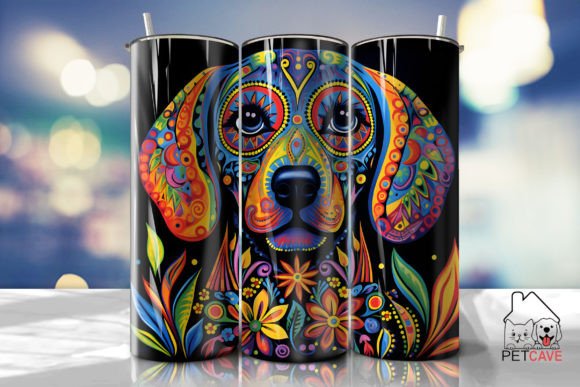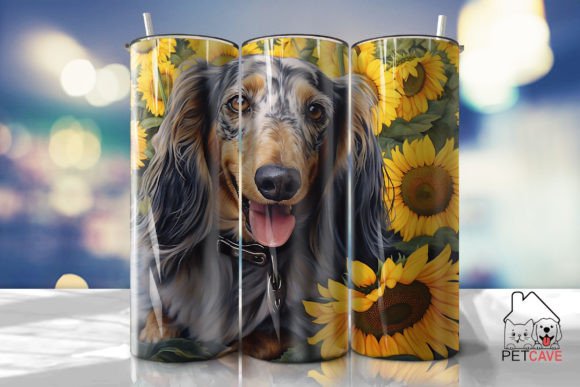
Intense Close-Ups Dachshund Tumbler Wrap
Let’s be real: not every dachshund design earns its place on a finished embroidered tote, baby onesie, or boutique apron. I’ve stitched hundreds of dog-themed motifs—from cartoon pups to hyper-realistic portraits—and the Intense Close-Ups Dachshund Tumbler Wrap stands out for one reason: it breathes personality *before* you even load it into your machine. As a designer who tests embroidery assets for commercial use—think Etsy listings, craft fair inventory, and custom client orders—I opened this ZIP file expecting another generic silhouette. Instead, I got two high-res PNGs (straight and tapered, both 9.3” × 8.2”, 300 DPI) that immediately suggested *intention*: this isn’t just a graphic—it’s a design built for translation into thread.
A First Impression That Translates to Stitch
The moment you zoom in, you see it—the expressive eyes, the subtle fur texture implied through contrast, the confident tilt of the head. It’s warm but not cutesy, detailed but not fussy. That balance matters when you’re planning an embroidered patch for a denim jacket or a sweatshirt front panel. Unlike many “dog wrap” graphics that flatten into a busy blur after digitizing, this one carries visual hierarchy: the muzzle anchors the composition, the ears frame without competing, and the tapered version subtly accounts for curvature—ideal if you’re wrapping it around a tumbler, a curved pillow cover, or even a contoured cap visor.
Where It Shines (and Where It Needs Thought)
I tested the Intense Close-Ups Dachshund Tumbler Wrap as a mockup for three real projects: a linen tea towel for a local pet boutique, a cotton-blend baby onesie for a holiday gift set, and a structured canvas tote for a small shop launch. On the towel? Brilliant. The straight version aligned cleanly with the hem, and the detail held up beautifully in satin stitch—even at 75% scale. On the onesie? Cautious optimism. The facial features are crisp enough for baby embroidery, but I’d recommend using lightweight cutaway stabilizer and reducing density slightly in the eye highlights to avoid stiffness against delicate skin.
For the tote bag, the tapered version made all the difference—it flowed naturally over the gusset seam without distortion. That said, don’t assume it’s plug-and-play for every surface. On highly textured fabrics like bouclé or thick terry cloth, fine details (like individual whiskers or nostril definition) may soften unless you adjust underlay stitches. And on stretchy knits? Always test first—and consider adding a tear-away + cutaway combo stabilizer. This isn’t a fault of the design; it’s just how embroidery physics works.
What It Adds to Your Finished Product
Customers notice authenticity before they notice technique. When someone sees this dachshund on a personalized gift—say, a kitchen towel monogrammed with a family name—they don’t think “cute dog.” They think “this person *gets* dachshunds.” That emotional resonance lifts perceived value. For Etsy sellers, that means fewer “Is this really hand-embroidered?” questions and more “How fast can you ship?” messages. For craft fair vendors, it means the design becomes a conversation starter—not just decor, but a shared smile between breeder, owner, and admirer.
Visually, it supports brand consistency without demanding rigid color rules. The PNG format gives you full control over thread palette: try deep charcoal grays on cream linen for a modern look, or vibrant rust and oat on navy for warmth. It also scales well for digital product previews—drop it into a printable mockup for your Etsy listing, and buyers instantly grasp proportion, mood, and placement.
Smart Embroidery Designer Notes
- Always test on scrap fabric first—especially if stitching on dark or textured substrates. What reads clearly on screen doesn’t always translate to dense fill stitch.
- Check thread color contrast early. The design relies on tonal nuance, so low-contrast combos (e.g., light tan on ecru) may lose definition.
- Review stitch density in your digitizing software. Since only PNGs are provided—not native embroidery files—you’ll need to digitize it yourself or hire a digitizer. Pay special attention to the eye area and ear edges; those zones benefit from balanced satin-to-fill transitions.
- Confirm hoop size compatibility. At 9.3” wide, this fits standard 5×7” hoops only when scaled down significantly—so plan for larger hoops (6×10” or bigger) if stitching at full size.
- Inspect small details in black-and-white mockups. If key features vanish in grayscale, they’ll likely get lost in dense stitching or on busy fabric backgrounds.
- Compare performance on light vs. dark fabric. Dark backgrounds often require underlay reinforcement; light fabrics may need top-stitch coverage to prevent show-through.
- Use proper stabilizer for your substrate—no shortcuts here. Even a well-designed motif will pucker or distort without appropriate backing.
- Verify licensing before selling finished items or digital products. This listing provides PNGs only; commercial use rights depend on the seller’s terms—not assumed by format alone.
Final Thought: A Design That Works With You
The Intense Close-Ups Dachshund Tumbler Wrap isn’t flashy—but it’s reliable. It doesn’t shout. It connects. That’s rare in the Crafts and Graphics space, where trends lean toward oversimplified icons or overly intricate line art. This sits in the sweet spot: expressive enough for handmade product storytelling, clean enough for scalable embroidery execution, and versatile enough for sweatshirt fronts, nursery pillows, holiday stockings, or even embroidered patches sewn onto denim jackets.
If you’re an embroidery designer building a library of go-to assets, a small shop owner curating seasonal collections, or a hobbyist making personalized gifts that feel intentional—not just assembled—this is one to keep open in your design folder. Not because it’s perfect out of the box, but because it invites thoughtful execution. And in embroidery, that’s where real craftsmanship begins.